|
|
|
|
|||
Mechanical work is an energy quantity, which measures with how much 'physical effort' a mechanical action was carried out, such as moving, lifting or deforming a body.
If a body is moved a distance d under the action of a force oriented in the direction and direction of travel, we say that that force has done mechanical work:
|
|
|
|
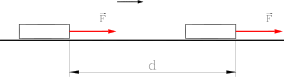
The unit of measurement of this physical quantity in the international system is:
|
|
(Joule) |
|
Thus, mechanical work has a simple, precise mathematical definition and based on it other energy quantities can be defined, as well as their common unit of measure: 1J.
Example: Someone pulls a package over a distance d=10m, applying a force F=100N. The mechanical work done is L=100N⋅10m=1000J=1kJ.
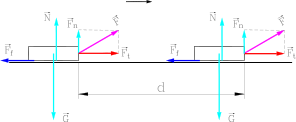
In general, several forces act on a body simultaneously. In the following example, a body has mass m=10kg, is on a flat horizontal surface and a tensile force is applied of 70N to be moved a distance d= 10m. The coefficient of friction is μ=0.65. Throughout the movement, 4 forces act:
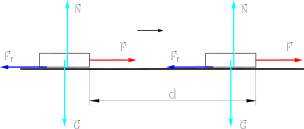
We can specify the mechanical work done by each of these forces, but we must keep in mind that the orientation of the force in relation to the direction of movement is essential:
|
force |
mechanical work |
observations |
|
traction force (70N) |
|
Traction force is oriented in the direction and direction of movement, it contributes to movement and . |
|
frictional force (65N) |
|
Frictional force is oriented in the direction of motion, but opposes motion and . |
|
the force of gravity (100N) |
|
The force of gravity is perpendicular to the direction of motion, it neither contributes to motion nor opposes motion, and so . |
|
normal pressure force (100N) |
|
The normal pressure force is also perpendicular to the direction of motion, and for the same reason . |
We treat displacement as a vector and we consider the orientation of the force in relation to the displacement vector in 3 particular cases:
|
|
|
is a driving force: acts on the direction and direction of movement and contributes to movement. Her mechanical work is positive. |
|
|
|
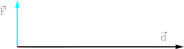
it acts perpendicular to the direction of travel and does no mechanical work. |
|
|
|
is a resistance force: acts in the direction of movement, but in the opposite direction and opposes movement. Her mechanical work is negative. |
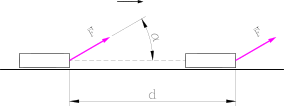
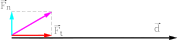
A force acts obliquely to the direction of movement:
|
|
|
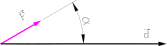
We can break it down into two components:
|
|
The tangential component of the force in the direction of travel has the size and perform mechanical work: |
|
The normal component of the force in the direction of displacement has the size and does not perform mechanical work: |
In conclusion, the mechanical work of an oblique force in the direction of displacement is:
Problem: A man pulls a sled of mass m=50kg over a distance d= 1 km.