


|
|
|
|
|||
This engine was invented by Nikolaus Otto around 1876.
Its operation is cyclical, in 4 stages (times):
Admission: a quantity of air is drawn into the cylinder and at the same time a proportional quantity of fuel (petrol) in a stoichiometric ratio: 14.7kg air/1kg petrol. In older engines, the air + gasoline vapor mixture is prepared by the carburetor. Most newer engines use an injector to inject precise amounts of gasoline into the cylinder.
Compression: the air + gasoline vapor mixture is compressed. For this stage it is necessary to carry out mechanical work on the engine.
Ignition and relaxation: The compressed mixture is ignited by an electric spark. There is an extremely rapid combustion (explosion) followed by expansion of the gases, this being the only phase in which the engine produces more mechanical work than it receives in the previous stage.
Evacuation: the burnt gases are removed from the cylinder and the next cycle is carried on.
The engine cannot start by itself, but must first be cranked (with a starter) to go through stages 1, 2 at least once. After the explosion (3) occurs, the engine receives a strong impulse and continues its motion from inertia until the next cycle explosion, after which it continues to operate autonomously, as long as it receives fuel and electric spark.
Ecological note: By achieving the stoichiometric mixture, all the gasoline burns and all the oxygen is consumed. If the mixture is rich (too much gasoline), not all the fuel burns, and the exhaust gases contain unburned gasoline (hydrocarbons). If the mixture is poor (too little gasoline), all the gasoline burns, but unconsumed oxygen remains which, at the high combustion temperature, combines with nitrogen, resulting in highly toxic nitrogen oxides (NOx i.e. NO and NO2), also called noxe.
The Otto engine is considered to operate according to the following thermodynamic cycle:
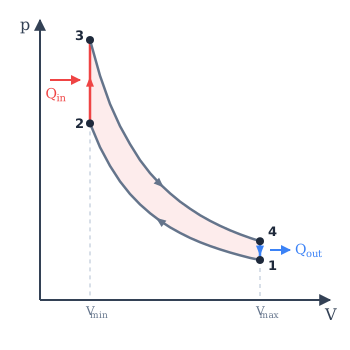
This engine has the following operating parameters:
compression ratio , which usually has values in the range ;
the adiabatic exponent of the working gas: . Normally the working gas is air, having .
The thermodynamic cycle includes 4 processes, between 4 states of thermodynamic equilibrium of a quantity º of air, considered as an ideal gas:
|
process |
equations |
heat Q |
mechanical work L |
internal energy variation ΔU |
|
1→2 adiabatic compression |
|
|
|
|
|
2→3 isochoric heating |
|
|
|
|
|
3→4 adiabatic expansion |
|
|
|
|
|
4→1 isochoric cooling |
|
|
|
|
State parameters in the 4 states of thermodynamic equilibrium:
|
STATUS |
volume V |
pressure p |
temperature T |
internal energy U |
|
1 |
|
p1 ≤ 1 atm |
T1=Tmin |
|
|
2 |
|
|
|
|
|
3 |
|
|
T3=TMAX |
|
|
4 |
|
|
|
|
In state 1, the amount of gas admitted into the cylinder at the start of the cycle has the minimum internal energy, being at the ambient temperature. Reached state 2 by a compression that requires mechanical work from the outside, the internal energy increases. After burning (the process 2→3), the temperature reaches a maximum value and the internal energy becomes maximum. Further (in the process 3→4) the engine produces mechanical work due to the decreasing internal energy. In the process 4→1 the gas cools down to its original temperature without doing any more mechanical work, and thus an amount of energy is unnecessarily lost.
The most important quality indicator is engine efficiency, equal to the ratio between the useful mechanical work and the energy consumed (heat received):
|
|
|
(1) |
To determine the efficiency, we must make an energy balance over an entire operating cycle, taking into account: how much heat the engine receives, how much it gives off, how much mechanical work it does, how much mechanical work it must consume to continue operating.
Throughout the cycle, the engine performs mechanical work only during adiabatic expansion 3→4 (L34>0), but the useful mechanical work is less, because part of it was consumed during the adiabatic compression 1→2 (IT12<0). Therefore: .
During the entire cycle, the engine receives heat only on explosion 2→3 (Qp=Q34>0) and gives up heat to process 4→1 (Qc=Q41<0). Therefore: .
It is easier to determine the efficiency as a function of heats Qp, Qc if we take into account that ethe internal energy is a state quantity and after completing a complete cycle its variation is 0: . According to the first principle of thermodynamics (valid for any process or sequence of processes):
The heat given off is negative and it is preferable to write so that:
|
|
|
(2) |
We replace the expressions of the 2 heats:
|
|
|
(3) |
Then:
|
|
|
(4) |
Using relationships between temperatures:
|
|
|
(5) |
we get:
|
|
|
(6) |
The end result, simplified:
|
|
|
(7) |
The ideal efficiency of the Otto engine depends theoretically (taking only thermal phenomena into account) only on compression ratio, which must be as large as possible. However, it cannot be too high either, because the mixture would heat up too much during the compression stage and the gasoline would ignite too early, causing the destructive phenomenon of detonation (premature ignition, before sparking).
Assortments of gasoline that differ in octane number are sold: CO95, CO98, CO100. The higher the octane number, the harder the gasoline ignites and can be used in engines with a higher compression ratio, so with better efficiency.
